
📌 Introduction: A Landmark Change in India’s Social Security Framework
On 21 November 2025, India moved a major step forward in modernising its social security architecture when the Central Government brought into force the Code on Social Security, 2020 through Gazette Notification No. 5143.
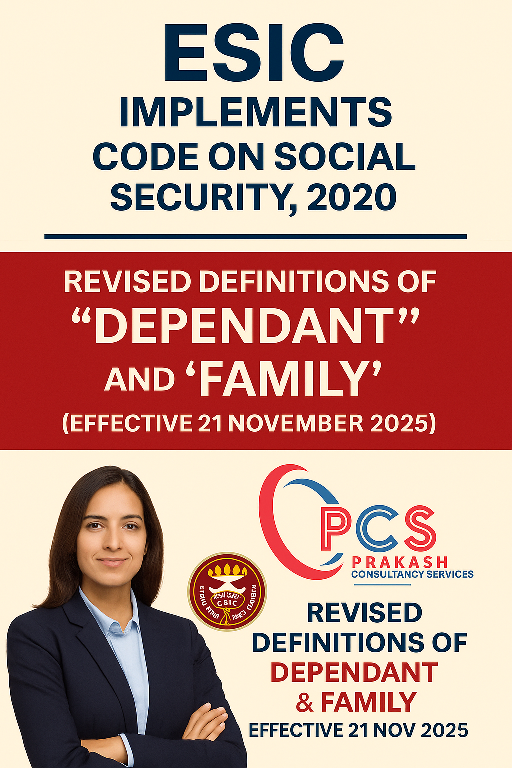
Following this, the Employees’ State Insurance Corporation (ESIC) issued an important clarification via its Headquarters Circular File No. N-11011/2/2025-BFT-II dated 28 November 2025, announcing revised statutory definitions of:
- “Dependant” – Section 2(24)(c)
- “Family” – Section 2(33)(e)
These definitions replace the earlier definitions under the ESI Act, 1948, which stands repealed. The update has significant implications on ESIC benefit eligibility, claim processing, employee declarations, and HR compliance mechanisms across India.
⭐ Why This ESIC Update Is Important? – Professional Context
This reform is not just a wording change—it transforms the benefit entitlement framework under ESIC.
The Social Security Code is designed to:
✔ Modernise ESIC benefits
✔ Expand the welfare net
✔ Recognise evolving family structures
✔ Promote gender-inclusive protection
✔ Standardise definitions across laws
These expanded definitions ensure that more dependants and family members of insured persons can now access ESIC benefits, which directly impacts:
- Employees
- HR teams
- Medical superintendents
- ESIC branch offices
- Compliance departments
- Organisation-wide welfare policies
1️⃣ Revised Definition of “Dependant” – Section 2(24)(c)
Under the Social Security Code, two important categories have now been added to the term “dependant”:
✔ Widower
✔ Grandparents
🔎 Deep Explanation (Professional Legal Analysis)
Under the old ESI Act, 1948, dependants were limited to spouse, minor children, infirm children, and partially to parents. However, with the enforcement of COSS 2020:
✔ A widower (husband of a deceased insured woman employee) is now officially recognised as a dependant
This is a path-breaking reform as it acknowledges:
- The financial dependency of a husband on a working spouse
- Rising dual-income and women-led households
- Gender-equal social protection
It ensures the widower becomes eligible for Dependent Benefit in cases where the woman insured person dies due to employment injury or covered contingencies.
✔ Grandparents included under dependant category
This is a major welfare expansion and reflects:
- Joint family structures in India
- Elderly dependency on earning members
- Societal shift towards multi-generational support
Grandparents can now legally receive ESIC Dependent Benefit, ensuring better protection for elderly citizens.
2️⃣ Revised Definition of “Family” – Section 2(33)(e)
For women employees, the definition of “family” has now expanded to include:
✔ Father-in-law
✔ Mother-in-law
🔎 Deep Explanation (Professional Legal Analysis)
This change aligns ESIC provisions with:
- Social norms where in-laws reside in the same household
- Women often contributing to medical expenses of in-laws
- The need for gender-balanced medical coverage
Under the ESI Act, 1948, these relations were not eligible for medical benefits. The Social Security Code corrects this gap by ensuring:
✔ Women employees can now add in-laws to ESIC records
✔ In-laws can receive full ESIC medical benefits
✔ ESIC’s family coverage becomes more inclusive and realistic
This supports millions of female employees working in:
- Factories
- Retail
- Services
- Healthcare
- Logistics
- IT/ITES
🧭 Operational & HR Impact – What Employers Must Do (Detailed, Professional Advisory)
The ESIC HQ circular places clear responsibility on organizations to ensure compliance.
Below are the mandatory action points:
📍 1. Update ESIC Declaration Forms (Form-1)
HR teams must immediately allow employees to add:
- Widower
- Grandparents
- Father-in-law
- Mother-in-law
📍 2. Modify HRMS, Payroll & ERP Systems
Your systems must support:
- New relationship categories
- ESIC integration fields
- Updated benefit eligibility mapping
- Claim processing validation based on new definitions
📍 3. Reassess Pending ESIC Claims
Claims previously rejected due to relationship status may now need to be reopened.
This includes:
- Dependent Benefit cases
- Medical Benefit claims for in-laws
- Death benefit eligibility
📍 4. Communicate the Update to All Employees
A formal communication must be issued, especially to:
- Women employees
- Employees supporting grandparents
- Employees with dependants in joint families
📍 5. Align This with the Broader Labour Code Implementation
This ESIC update is part of the larger reform under the Four Labour Codes, which bring changes to:
- Wage definition (50% rule)
- PF, ESI, Gratuity applicability
- Compliance timelines
- Penalties under Social Security Code
- Medical & dependent coverage
- Benefit contribution ceilings
Companies must be ready for full compliance audits, documentation alignment, and HR restructuring.
PCS strongly recommends a Code on Social Security – ESIC Readiness Assessment for all establishments.
📘 Legal References (for documentation & audit)
- Code on Social Security, 2020 – Section 2(24): Dependant
- Code on Social Security, 2020 – Section 2(33): Family
- Gazette Notification No. 5143 dated 21 November 2025
- ESIC HQ Circular File No. N-11011/2/2025-BFT-II dated 28 November 2025
These should be archived in the organization’s Statutory Register – ESIC Compliance.
🎯 Conclusion (Professional & Impactful)
The implementation of the Social Security Code, 2020 and the revised definitions announced by ESIC mark a historic expansion in India’s social welfare system. By recognizing widowers, grandparents, and in-laws within the ESIC coverage framework, the Government has taken a progressive step aligned with the realities of modern Indian families.
Employers must now ensure immediate compliance, update internal systems, revise records, and educate employees so that eligible dependents receive their rightful ESIC protections without delay.
PCS will continue monitoring every update under the Four Labour Codes and issue timely advisories to keep organizations fully compliant.
Download the Notification:-⬇️Implementation_the_Code_on_Social_Security_2020_English_1764326385