Monday, August 31, 2026
29 C
Mumbai
Advising, Administration, Documentation and Maintenance of various records and statutory compliance
Home Blog Page 45

Bonus Payable Guidelines ( West Bengal ) for the Year 2020

 The Government of West Bengal vide circular No. Labr./210/(LC-IR)/3C-01/18 has issued guidelines to be followed by all employers and employees of the state covered under the Payment of Bonus Act, 1965 (”Act”) while settling the legitimate dues of the workers in respect of bonus for the year 2020 in terms of the said Act in the interest of maintenance of Industrial peace and harmony,:-                                                                                       

(1) It is expected that the employers would adopt a flexible attitude on the issue of the payment of bonus                            

(2) All establishments where the bonus was paid in the previous year are requested to see that the rate of bonus payable this year is not lower than that of last year. Employers are also requested to consider payment of an amount of exgratia in lieu of bonus as is admissible at the maximum stage to those employees who have crossed the eligibility limit as per the Act                                                                   

(3) All employees, whether in casual employment/re-employment after retirement/employed through contractors and have worked for not less than 30 days during the year should be paid a bonus                                                         

(4) The employers in default towards payment of bonus for the previous year are requested to make such payments this year along with the bonus for the current year.                                                                                                            

(5) The Government appeals to all trade unions and employers’ organization to extend their cooperation in peaceful and effective settlement of industrial disputes concerning bonus without any disruption of work                                     

(6) The Government has noted that in many cases, in previous years, employees of the IT sector, Hotel and Restaurants, Shops & Establishments, Security Workers, and some workers in jute mills did not get any bonus. It is hoped that the situation will not be similar this year.                                                                                                                 

(7) All payments of bonus should be made before the commencement of Durga Puja, 2020.                                        

Even employers in an unorganized sector where most employees are not covered under the Act are expected to pay bonus/ex-gratia to their workers before the commencement of Durga Puja, 2020. 

Hence, all employers having their establishments in West Bengal may make note of the above guideline and comply accordingly


Notification:- 👉 Guidelines To Settle The Legitimate Dues Of Workers Under The Payment Of Bonus Act, 1965 In West Bengal

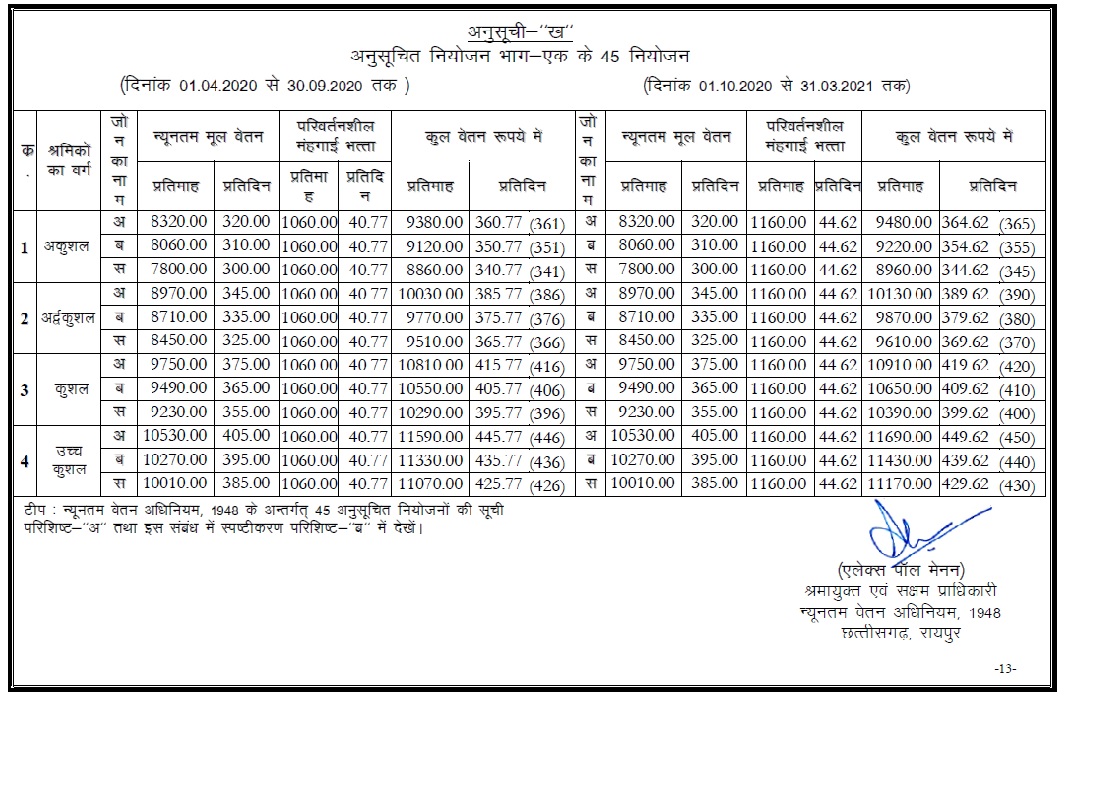
Chhattisgarh Minimum wages from 1st Oct 2020 to 31st Mar 2021


Chattisgarh Minimum Wages have been revised from 1st Oct 2020 to 31st Mar 2021

Madhya Pradesh Minimum Wages from 1st Oct 2020 to 31st Mar 2021


The Labour Department of Madhya Pradesh State has revised the minimum wages of several categories, which is valid from 1st October 2020 to 31st March 2021.


Class of Employment

Basic Per Day

Basic Per Month

VDA Per Day

VDA Per Month

Total Per Day

Total Per Month

Highly Skilled

374.42

9735.00

84.62

2200.00

459.03

11935.00

Semi-skilled

271.42

7057.00

84.62

2200.00

356.03

9257.00

Skilled

324.42

8435.00

84.62

2200.00

409.03

10635.00

Unskilled

250.00

6500.00

73.08

1900.00

323.07

8400.00

Haryana Minimum Wages notification W.E.F 1st Jan 2020

 The Haryana Government vide Notification I.R – 2/2020/7740-7868 has released the variable D.A allowance in Minimum Wages

Effective from Date: 1st Jan 2020 Updated As On: 30th Sep 2020

Class of Employment

Qualification and experience

Basic Per Day

Basic Per Month

Total Per Day

Total Per Month

Unskilled

NA

292.31

7,600.00

358.43

9,319.12

Semi Skilled Class A

NA

306.92

7,980.00

376.35

9,785.05

Semi-Skilled Class B

NA

322.27

8,379.00

395.17

10,274.29

Skilled Class A

NA

338.38

8,797.95

414.92

10,788.01

Skilled Class B

NA

355.30

9,237.85

435.67

11,327.42

Highly Skilled

NA

373.07

9,699.74

457.45

11,893.79

Clerical & General Staff

Below Matriculation

306.92

7,980.00

376.35

9,785.05

Clerical & General Staff

Matriculation but not Graduate

322.27

8,379.00

395.17

10,274.29

Clerical & General Staff

Graduate or Above

338.38

8,797.95

414.92

10,788.01

Clerical & General Staff

Steno Typist

322.27

8,379.00

395.17

10,274.29

Clerical & General Staff

Junior Scale Stenographer

338.38

8,797.95

414.92

10,788.01

Clerical & General Staff

Senior Scale Stenographer

355.30

9,237.85

435.67

11,327.42

Clerical & General Staff

Personal Assistant

373.07

9,699.74

457.45

11,893.79

Clerical & General Staff

Private Secretary

391.72

10,184.73

480.33

12,488.48

Data Entry Operator

NA

338.38

8,797.95

414.92

10,788.01

Driver

Light Vehicle

355.30

9,237.85

435.67

11,327.42

Driver

Heavy Vehicle

373.07

9,699.74

457.45

11,893.79

Security Guard

Without Weapon

306.92

7,980.00

376.35

9,785.05

Security Guard

With Weapon

355.30

9,237.85

435.67

11,327.42

The renewal procedures for “Certificates / Registrations / Licenses” for establishments has been simplified by Govt of Karnataka

 The renewal procedures for “Certificates / Registrations / Licenses” for establishments has been simplified by Govt of Karnataka by introducing an auto-renewal system upon prescribed online payment of fees under the following Acts and Rules henceforth.


1. Registration under the Karnataka Shops and Commercial Establishment Act, 1961

2. License under the Contract Labour (Regulation and Abolition) Act, 1970

3. License under the Inter-State Migrant Workmen (Regulation of Employment & Conditions of Service) Act, 1979

4. License under the Factories Act, 1948

The detailed notification is attached for your reference please,

👉 Simplification of Renewal – Karnataka – Notification

ESIC Coverage Reduce to 10 Employees count in Maharashtra

With effect from 1st October 2020, the provisions of ESI ACT, in Maharashtra will apply to establishments employing 10 or more persons irrespective of the Salary paid to them.

If no employee is eligible then the company will register and file nil returns. If even 1 employee is eligible then the company will register and file contribution returns.


The Following Schedule Classes of Establishment wherein 10 or more person are employed or were employed on any day of the preceding twelve months  in the areas  in which the provision of the said act have been brought into force under subsection (3) of section 1 of the said act  

1. Shops.

2. Hotels.

3. Restaurants. 

4. Road Motor Transport Establishment. 

5. Cinema Including Preview Theatres. 

6. Newspaper establishment as defined in section 2 (d) of the working journalists       (condition of Service) & Miscellaneous provision Act ( 45 of 1995).  

Notification :- ESIC 10 Employees Coverage Notification -Maharashtra 1st October 2020

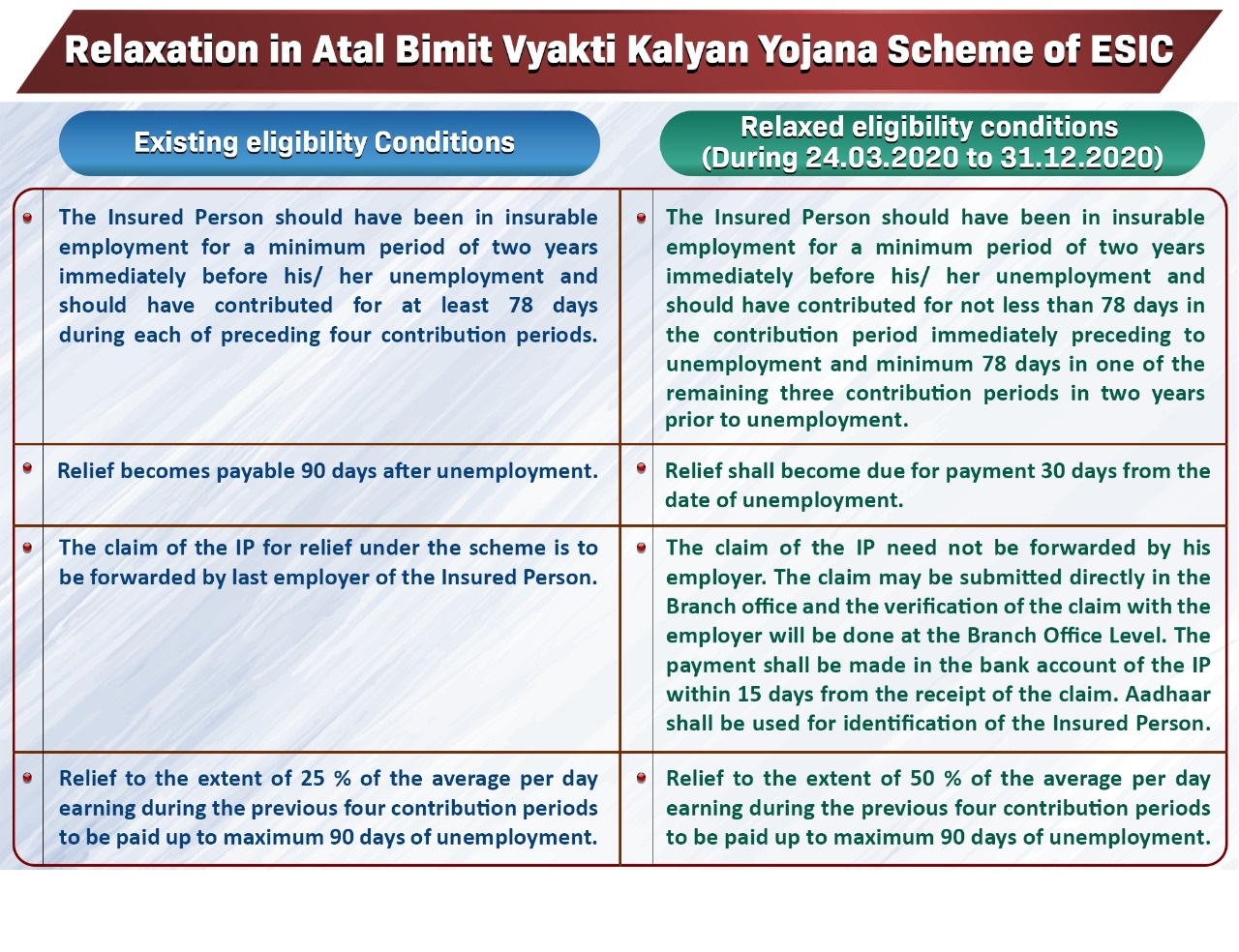
Atal Bimit Vyakti Kalyan Yojana Scheme of ESIC ( Unemployment allowance)

3

 Atal Beemit Vyakti Kalyan Yojana finally notified by Govt. with the following highlights;


1. Valid from 1.7.2020 to 30.6.2021


2. 2 years of employment is required in insurable employment just before his/her unemployment


3. Min. 78 days contribution is a must in each 4 preceding contribution periods just before unemployment.


4. The claim shall be due after 30 days from the date of unemployment.


5. The claim shall be settled by the ESIC within 15 days from the date of lodging the claim and money shall be transferred to the insured person’s bank account directly. Insured Person to lodge the claim directly to the ESIC Branch Office.


6. Salary shall be paid to the unemployed Insured Person @50% of average per day earned during the previous 4 contribution periods maximum for 90 days that is 3 months.


Gazette Copy:- ESIC Unemployment allowance-Gazette

 Steps for Eligibility conditions & claim process 


1. Login  the  IP portal  on http://www.esic.in/EmployeePortal/login.aspx by  entering  his  insurance number and captcha at the designatedplace.


2. On loggingin the IP portal, the IP shall click the link providedfor the creation of a claim for the Atal Beemit Vyakti Kalyan Yojana.


3. The system will check IPs eligibility and if IP is eligible for the relief underthe scheme it will take him to the next page where the IP will fill up the period for which he/ she seeks relief under the ABVKY  and submit it to create a claim


4. The systemwill then promptthe eligible IP to print a copy of the claim thus created (form AB1).  


5.  The claim thus generatedwill have the information which is available in the system, auto-filled in it.


6. The claim duly signed in the form of an affidaviton non• judicial  stamp paper  of minimum  Rs 20/- value will be submitted by the IP to his designated branch office either in person or by speed post along with a selfattested photocopyof Aadhar card and that of the bank passbookor a canceled cheque.


7. The Bank details are to be matched with the canceled cheque in the IP Portal 


“Income Tax Policy Changes” – Announced by CBDT:*


“Income Tax Policy Changes” – Announced by CBDT:*
*1. Income Tax New disclosures asked in the new ITR forms 1to7 are: 1. House ownership: Individual taxpayers who are joint owners of house property cannot file ITR 1 or ITR4.*

*2. Passport: One needs to disclose the Passport number if held by the taxpayer. This is to be furnished both in ITR 1-Sahaj and ITR 4-Sugam. Hopefully, it will be made mandatory in other ITR Forms as and when they are notified.*

*3. Cash deposit: For those filing ITR 4-Sugam, it has been made compulsory to declare the amount deposited as cash in a bank account, if such amount exceeds Rs 1 crore during the FY.*

*4. Foreign travel: If you have spent more than Rs 2 lakh on traveling abroad during the FY, you need to disclose the actual amount spent.*

*5. Electricity consumption: If your electricity bills have been more than Rs 1 lakh in aggregate during the FY, you need to disclose the actual amount.*

*6. Investment details: Details of investment qualifying for deduction under chapter VIA with the bifurcation of details of investment made during the period from April 1, 2020, to June 30, 2020.*

*7. For every assessment year, the last date for filing tax returns is July 31, However, this year ITR filing date has been extended till November 30, 2020, due to pandemic Covid-19.*

*8. Income Tax Exemptions and Deductions that you can claim under the New Tax Regime for FY 2020-21 (AY 2021-22): Withdrawal by an employee from the Employees’ Provident Fund (EPF) is not taxable after 5 years of continuous service.*

*9. Withdrawal from the National Pension Scheme (NPS) on maturity or premature closure up to 40% of the amount received on such withdrawal remains tax-free for all. In case of partial withdrawal from NPS, up to 25% of the contributions made by the individual will be tax-free. Employer’s contribution to NPS up to 10% of their basic salary and dearness allowance also remains tax-free.*

*10. Under Section 10 (10D) of the Income Tax Act, the sum assured and any bonus paid on maturity or surrender of the life insurance plan is tax-free. Maturity proceeds continue to be exempt under Section 10(10D) even in the new regime. The maturity amount including interest received on the Sukanya Samriddhi Yojana will not attract any tax.*

*11. Conveyance Allowance granted to meet expenditure incurred on conveyance in performance of duties of an office and any allowance granted to an employee to meet the cost of travel on tour or on transfer (including relocation) are tax-free.*
*Interest received from post office savings account balance up to ₹3,500 annually per individual will remain free from tax.*

*12. Any scholarship granted to meet education costs is tax-exempt under Section 10 (16) of the Income Tax Act. Gratuity received from the employer up to ₹20 lakh after rendering 5 years of continuous service. Leave encashment received at the time of resignation or retirement up to ₹3 lakh.*

*13. Form 26AS will now be a complete profile of the taxpayer w.e.f. 01.06.2020, CBDT vide Notification dated May 28, 2020 amended Form 26AS in Sec 285BB w.e.f. 01.06.2020. Key takeaways are:*

*14. New form 26AS will also provide information in respect of “Specified financial transactions” which include transactions of purchase/ sale of goods, property, services, works contract, investment, expenditure, taking or accepting any loan or deposits of such value as may be prescribed but not less than of Rs 50,000.*

*15. Information about income tax demand, refund, proceedings pending, and proceedings completed which may include assessment, reassessment under section 148,153A 153C, revision, the appeal will also be shared in this form 26AS.*

*16. Information on this form 26AS will not be a one-time affair at year-end. This will be a live 26AS, as this will be updated regularly within 3 months from the end of the month in which such information is received.*

*17. Form 26AS will now be a complete profile of the taxpayer for that particular year as against earlier form 26AS which just provided the information about taxes

Inspections Under Various Labour Laws To Facilitate Ease Of Doing Business In The State Of Puducherry

 Government of Puducherry vide G.O. Ms No. 05/Lab/AIL/G/2020 has issued an order to introduce computerized systems of Risk Assessment based Inspections with random allocation of Inspecting Officers to facilitate Ease of Doing Business in the State. 


As per the order, inspection will be carried out by respective Inspection Officers to categorized establishments as Low Risk / Medium Risk / High Risk depending upon the number of workers employed. The frequency for inspection for establishments under the Medium Risk category will be once in two years and for Establishments under the High-Risk category will be once in every year.

Therefore, the aforementioned scheme shall be applicable to the following acts – 

  • The Puducherry Shops And Establishments Act, 1964, 
  • The Puducherry Catering Establishments Act, 1964, 
  • The Contract Labour (Regulation And Abolition) Act, 1970, 
  • The Inter-State Migrant Workmen (Regulation Of Employment And Conditions Of Service) Act, 1979, 
  • The Child And Adolescent Labour (Prohibition And Regulation) Act, 1986, 
  • The Maternity Benefit Act, 1961, 
  • The Motor Transport Workers Act, 1961, 
  • The Minimum Wages Act 1948, 
  • The Maternity Benefit Act, 1961, 
  • The Payment of Bonus Act, 1965, 
  • The Equal Remuneration Act, 1976, 
  • The Payment of Gratuity Act, 1972, 
  • The Payment of Wage Act, 1936, 
  • The Sexual Harassment Of Women At Work Place (Prevention, Prohibition And Redressal) Act, 2013, 
  • The Puducherry Industrial Establishments (National And Festival Holidays) Act, 1964, 
  • The Puducherry Industrial Establishments (Conferment Of Permanent Status To Workmen) Act, 1981, 
  • The Industrial Employment (Standing Orders) Act, 1946, The Working Journalists And Other Newspaper Employees (Conditions Of Service) and Miscellaneous Provisions Act, 1955, 
  • The Sales Promotion Employees (Conditions Of Service) Act, 1976. 

Proposal for the specification of festival Holidays) and Form III approval issued by the authority online under Tamil Nadu Industrial Establishments (National, Festival And Special Holidays) Act, 1958 and Rules, 1959.

 The Labour Department of Tamil Nadu has decided to implement online submission of Form I (Proposal for the specification of festival Holidays) and Form III approval issued by the authority online under Tamil Nadu Industrial Establishments (National, Festival And Special Holidays) Act, 1958 and Rules, 1959. This implementation would come into effect from August 16, 2020. However, the Authority would not accept the hard copy of the application.  

The employer may create a User ID and Password in the labour portal – https://labour.tn.gov.in/services/users/login.   Along with it, the following details need to get submitted:-

1. Employer SPOC mail ID, Mobile No., PAN and Aadhaar (residential address should be in Tamil Nadu) 

2. Employer PAN and Aadhaar (residential address should be in Tamil Nadu)

3. Holiday list colour scan copy (Minimum 9 _ four national and five festival holidays) 

4. Form II colour scan copy

5. Form S colour scan copy 

6. Lease agreement

7. Incorporate certificate 

8. Company PAN Card