
The implementation of the Code on Social Security, 2020 (CoSS 2020) with effect from 21 November 2025 marks a major milestone in India’s social security reforms. By unifying and modernising several welfare legislations, the Code aims to ensure that employees across all sectors—particularly the education sector—receive comprehensive medical and financial protection.
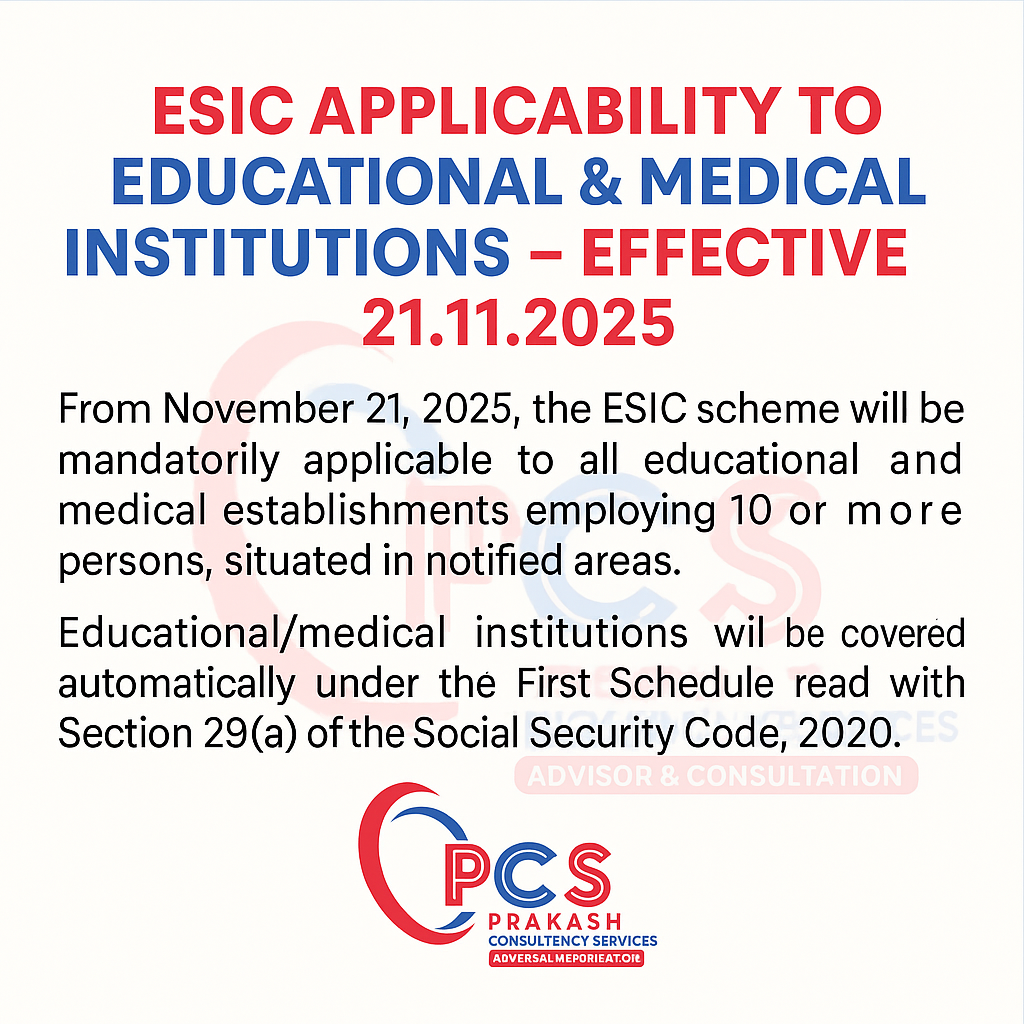
Following the nationwide enforcement of the Code, the Regional Office, ESIC Ahmedabad has formally directed all educational institutions—aided, unaided, private schools, colleges, training centres, and affiliated institutions—to immediately register under the Employees’ State Insurance Corporation (ESIC) and enroll all eligible employees as per statutory requirements.
This directive significantly elevates the compliance responsibilities of educational institutions across the region.
1. Background: ESIC Coverage Now Mandatory for Educational Institutions
Under CoSS 2020, the definition of “establishment” has broadened substantially. Educational institutions—earlier not uniformly covered—are now explicitly recognised under the expanded scope.
As a result:
-
All teaching and non-teaching staff falling within the wage threshold must be covered.
-
Institutions are legally obligated to align with ESIC registration and contribution procedures.
-
Employees become entitled to statutory social security benefits, including medical care, maternity protection, disability benefits, and dependent support.
This shift ensures that the education sector is on par with other industries in terms of workforce protection and welfare.
2. Mandatory Compliance Requirements for Institutions
The directive issued to educational authorities highlights three immediate actions:
a) Register as an ESIC Establishment
Every school, college, or educational institution employing eligible persons must complete its statutory registration under ESIC.
b) Enroll All Eligible Employees
Both academic and administrative employees must be registered without exception, ensuring universal coverage for those who fall within the wage limit.
c) Ensure Timely Monthly Contribution Payments
Institutions must deposit contributions within prescribed timelines to enable employees to receive uninterrupted benefits such as:
-
Medical benefits
-
Sick leave and disability compensation
-
Maternity benefits
-
Dependent benefits
-
Funeral expenses
Timely compliance also protects institutions from penalties arising out of delayed payments.
3. Applicability: Institutions Required to Comply
The directive applies to all educational institutions, including:
-
Aided schools and colleges
-
Unaided and private institutions
-
Recognised and affiliated educational bodies
-
Training institutes and academies
-
Any establishment employing eligible persons
Educational authorities have also been asked to circulate the directive widely and maintain an updated list of institutions falling under their jurisdiction.
4. Why Immediate Compliance Is Crucial
Institutions must prioritise ESIC registration and coverage due to the following reasons:
-
Statutory Mandate: ESIC registration is compulsory under CoSS 2020 wherever eligibility criteria are met.
-
Risk of Financial Liability: Delayed compliance may lead to retrospective contribution demands, interest, and damages.
-
Regulatory Scrutiny: Non-compliance invites inspections, audits, and potential legal action.
-
Employee Welfare: Timely registration ensures that staff members receive essential welfare protections.
-
Institutional Reputation: Compliance reflects professionalism and commitment to employee well-being.
Acting early mitigates risk and ensures seamless adoption of the new regulatory environment.
5. Practical Implications for Schools and Colleges
| Compliance Area | Impact Under CoSS 2020 |
|---|---|
| Coverage | All educational institutions employing eligible persons must register. |
| Cost Obligations | Employer and employee ESIC contributions become mandatory. |
| Administrative Responsibilities | Monthly filings, wage reporting, and record maintenance. |
| Employee Benefits | Comprehensive medical and financial protections. |
| Non-Compliance Risks | Interest, penalties, legal scrutiny, and backdated liabilities. |
These implications require institutions to strengthen their HR, payroll, and compliance frameworks.
6. PCS Expert Analysis
The education sector is now clearly under the ESIC coverage umbrella, signalling a strategic move towards universal social security. Institutions must respond with structured compliance measures to avoid unnecessary financial and legal exposure.
PCS recommends the following steps:
-
Conduct an immediate ESIC eligibility assessment
-
Register the institution on the ESIC portal
-
Add all eligible employees to the ESIC system
-
Train HR and payroll teams for operational compliance
-
Maintain documentary evidence for audit readiness
Prakash Consultancy Services (PCS) is already supporting numerous educational institutions in adapting to these new requirements through end-to-end ESIC registration, filing, and compliance oversight.
7. Conclusion
The ESIC Ahmedabad directive is a clear signal that educational institutions must align with the requirements of the Code on Social Security, 2020 without delay. Mandatory registration and employee coverage are essential parts of this transition, ensuring robust social security for thousands of teachers, staff members, and support personnel across the region.
By embracing compliance early, institutions can safeguard themselves from penalties, streamline operations, and reinforce their commitment to the welfare of their workforce.
Circular:- DEO Ahmedabad city_00601 (1)