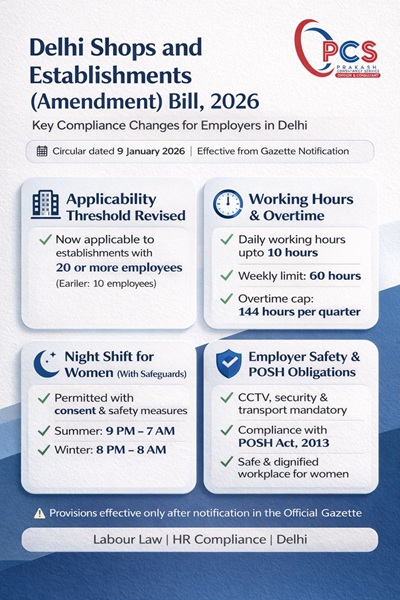

The Delhi Shops and Establishments (Amendment) Bill, 2026 marks a significant shift in labour law compliance for businesses operating in Delhi. Issued vide Circular No. F. No. 21/8/DSAE(A)/2026/LAS-VIII/Legn./16203 dated 9 January 2026, the Bill proposes structural changes to working hours, overtime limits, night-shift employment of women, and employer safety responsibilities.
These amendments seek to modernise workplace regulations while balancing business flexibility with employee welfare and safety.
📌 Effective Date:
The provisions of the Bill shall come into force only from the date notified by the Government of NCT of Delhi in the Official Gazette.
Legal Framework and Background
The Bill proposes amendments to the Delhi Shops and Establishments Act, 1954, which governs conditions of employment in shops, commercial establishments, offices, and service organizations across Delhi.
The proposed changes are aligned with evolving workforce patterns, extended business hours, and enhanced focus on women’s safety and dignity at the workplace.
1. Applicability Threshold Increased to 20 Employees
What is the Change?
-
The Act will now apply to shops and establishments employing 20 or more employees
-
Earlier threshold: 10 or more employees
Compliance Impact
-
Establishments employing 10 to 19 employees may no longer be covered under the Delhi Shops Act
-
Employers must reassess:
-
Registration status
-
Statutory leave and working hour obligations
-
Record-keeping and inspection exposure
-
2. Extended Daily Working Hours – Up to 10 Hours
Proposed Amendment
-
Maximum daily working hours increased to 10 hours
-
This includes rest intervals and meal breaks
Employer Responsibility
-
Shift scheduling must remain humane
-
Overtime rules continue to apply beyond prescribed limits
3. Weekly and Quarterly Working Hour Limits Introduced
New Limits
-
Maximum weekly working hours: 60 hours
-
Maximum overtime: 144 hours in a quarter
Why This Is Important
-
Introduces a quarterly compliance framework
-
Requires accurate:
-
Attendance tracking
-
Payroll computation
-
Overtime reconciliation
-
4. Flexible Overtime Provisions with Quarterly Cap
The Bill provides greater flexibility in overtime deployment by allowing more overtime hours per week, subject to the overall quarterly ceiling of 144 hours.
Compliance Reminder
-
Overtime wages must be paid at statutory rates
-
Excess overtime beyond limits may result in penalties and inspection objections
5. Night Shift Employment for Women Employees
One of the most progressive features of the Bill is the regulated permission to employ women in night shifts, subject to consent and safety safeguards.
Permissible Night Shift Timings
| Season | Permitted Timing |
|---|---|
| Summer (April–September) | 9:00 PM to 7:00 AM |
| Winter (October–March) | 8:00 PM to 8:00 AM |
Mandatory Conditions
-
Written consent of women employees
-
No coercion or adverse employment action
-
Adequate safety and welfare arrangements
6. Employer Liability for Women’s Safety at Workplace
Employers engaging women during night shifts must provide:
-
CCTV surveillance
-
Adequate security personnel
-
Safe pick-up and drop transportation
-
Secure workplace infrastructure
Failure to comply may expose employers to statutory penalties, prosecution, and reputational risk.
7. Prohibition on Night Employment of Children
The Bill strictly prohibits employment of children or young persons during night hours, reinforcing child labour protections under existing labour laws.
SEO Keywords: child labour night shift prohibition, Shops Act child employment
8. Mandatory POSH Compliance Reinforced
Employers must comply with the Prevention of Sexual Harassment of Women at Workplace Act, 2013.
Key POSH Obligations
-
Constitution of Internal Committee (IC)
-
POSH policy implementation
-
Employee awareness and training
-
Safe and harassment-free workplace
Non-compliance may result in dual liability under POSH law and Shops Act provisions.
Employer Compliance Checklist – Action Points
✔ Review employee headcount and applicability
✔ Update working hour and overtime policies
✔ Implement quarterly overtime tracking systems
✔ Draft women night-shift consent and safety SOPs
✔ Strengthen POSH compliance and documentation
✔ Prepare for enforcement upon Gazette notification
Conclusion
The Delhi Shops and Establishments (Amendment) Bill, 2026 introduces a new compliance architecture for employers by extending working hour flexibility while simultaneously imposing heightened safety, monitoring, and governance obligations.
Employers operating in Delhi should proactively realign HR policies, payroll systems, and compliance frameworks to avoid regulatory exposure once the amendments are notified and enforced.
Notification:-Delhi Shop Act Amendment