
Delhi Shops and Establishments (Amendment) Act, 2026
Gazette Notification dated 11 March 2026 – Professional Explanation
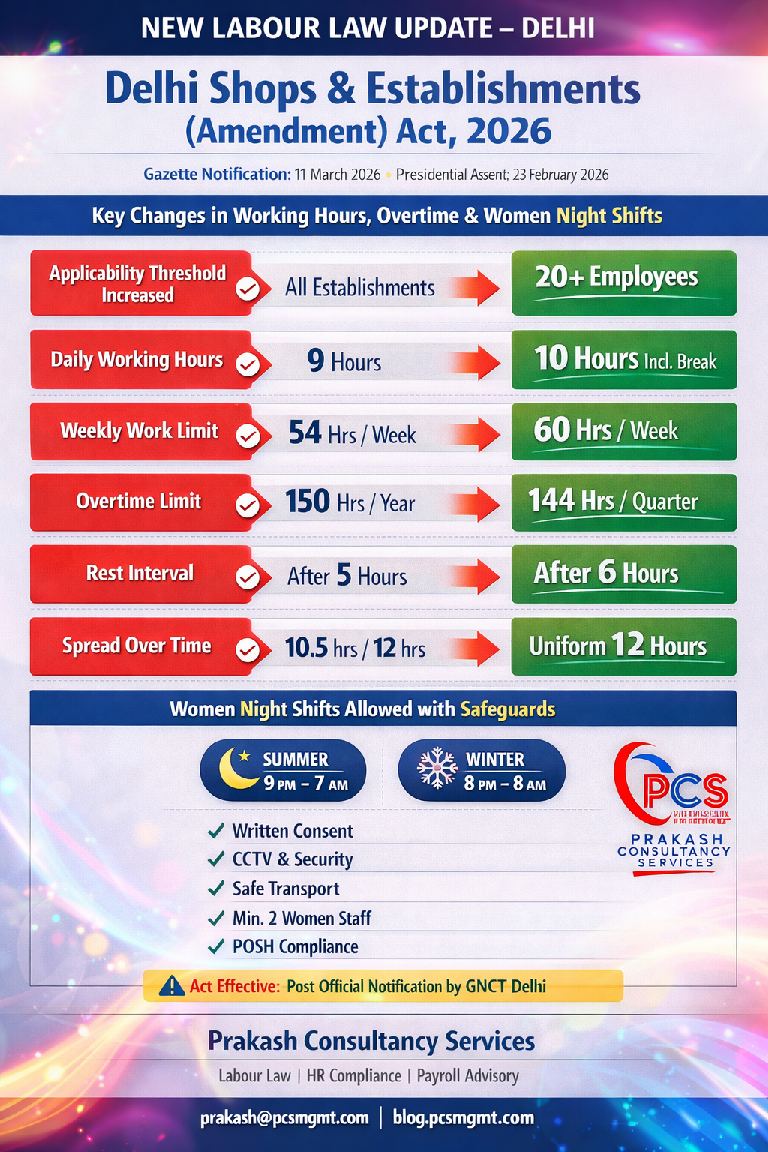
The Department of Law, Justice and Legislative Affairs, Government of National Capital Territory of Delhi, vide notification dated 11 March 2026, has published The Delhi Shops and Establishments (Amendment) Act, 2026 (Act No. 03 of 2026) after the Act received the assent of the President of India on 23 February 2026.
This amendment seeks to modify certain provisions of the Delhi Shops and Establishments Act, 1954 in order to align the law with the contemporary employment environment, flexible working arrangements, and gender-inclusive workplace practices.
The amendments primarily relate to:
- Applicability of the Act
- Working hours
- Overtime limits
- Employment of women during night shifts
- Spread over of working hours
- Minimum age provisions
It is important to note that the amendment shall come into force on such date as may be notified by the Government of NCT of Delhi in the Official Gazette.
Until such date is notified, the existing provisions of the Delhi Shops and Establishments Act, 1954 shall continue to remain in force.
1. Amendment Relating to Applicability of the Act
(Insertion of Sub-Section (5) in Section 1)
The amendment introduces a new sub-section (5) under Section 1, providing that:
“The Act shall be applicable to shops and establishments employing twenty or more employees.”
Explanation
Previously, the Delhi Shops and Establishments Act was generally applicable to all shops and establishments irrespective of employee strength.
Through this amendment, the legislature has introduced a threshold requirement, restricting the applicability of the Act to establishments employing twenty or more employees.
Practical Implication
This amendment effectively provides regulatory relief to small establishments, as establishments employing less than twenty persons may fall outside the regulatory scope of the Act, unless covered under any other applicable labour legislation.
This measure is also aligned with the Government’s objective of ease of doing business and reducing compliance burden on micro establishments.
2. Amendment Relating to Minimum Age of Employment
(Amendment in Section 2)
The amendment substitutes the expression “twelfth year” with “fourteenth year”.
Explanation
This change enhances the minimum age threshold for employment under the Act from 12 years to 14 years.
The amendment is consistent with the principles of the Child Labour (Prohibition and Regulation) Act, 1986, and reflects the policy objective of discouraging child labour and promoting education among minors.
3. Amendment Relating to Working Hours
(Amendment in Section 8)
The amendment revises the permissible daily working hours.
Earlier provision permitted an employee to work up to nine hours in a day.
Under the amendment, the words “nine hours” have been substituted by “ten hours inclusive of rest interval and lunch break.”
Explanation
This provision permits greater flexibility in structuring daily work schedules, particularly in sectors such as:
- Retail
- Hospitality
- IT services
- E-commerce operations
- Customer support services
The inclusion of rest interval and lunch break within the ten-hour limit clarifies the permissible working schedule under the Act.
4. Amendment Relating to Weekly Working Hours and Overtime
The amendment revises the limits relating to overtime work.
Earlier, the Act permitted overtime work up to 54 hours in a week and 150 hours in a year.
Under the amendment:
- Weekly working hours may extend up to 60 hours in a week, and
- Overtime work shall not exceed 144 hours in a quarter.
Explanation
The introduction of quarterly overtime limits replaces the earlier annual limit, thereby providing employers with greater operational flexibility in managing seasonal or peak business requirements.
However, employers must ensure that overtime is properly recorded and compensated in accordance with applicable labour laws.
5. Amendment Relating to Rest Intervals
(Amendment in Section 10)
The amendment substitutes the words “five hours” with “six hours.”
Explanation
Earlier, an employee was required to be provided a rest interval after five hours of continuous work.
Under the amended provision, an employee may work up to six hours continuously before being entitled to a rest interval.
This change reflects modern workplace practices and operational flexibility in commercial establishments.
6. Amendment Relating to Spread-Over of Working Hours
(Amendment in Section 11)
The earlier provision provided separate limits for shops and commercial establishments:
- 10½ hours in commercial establishments
- 12 hours in shops
The amendment replaces these limits with a uniform spread-over limit of twelve hours.
Explanation
This change simplifies the regulatory framework and ensures uniformity in compliance requirements for different categories of establishments.
7. Substitution of Section 14 – Employment of Women in Night Shifts
The amendment replaces Section 14 with a new provision allowing women employees to work during night hours, subject to specific safeguards.
Permissible Working Hours
Women employees may work:
- Between 9:00 PM and 7:00 AM during summer season
- Between 8:00 PM and 8:00 AM during winter season
Mandatory Safeguards
Employers must comply with the following conditions:
- Written consent of the woman employee must be obtained.
- Adequate CCTV surveillance must be installed in the workplace.
- Security arrangements must be provided for women employees.
- Safe transport facilities must be provided during night shifts, including for employees engaged through contractors.
- At least two women employees must be present during the night shift.
- Employers must strictly comply with the provisions of the
Prevention of Sexual Harassment of Women at Workplace (Prevention, Prohibition and Redressal) Act, 2013.
Protection During Maternity Period
The provision further clarifies that no employer shall knowingly employ a woman during the six weeks following confinement or miscarriage.
Explanation
This amendment represents a progressive step toward gender-inclusive employment, particularly benefiting sectors such as:
- Information technology
- Business process outsourcing
- Retail chains
- Hospitality sector
- Customer support operations
At the same time, the law imposes strict safety and welfare obligations upon employers.
Conclusion
The Delhi Shops and Establishments (Amendment) Act, 2026 introduces significant reforms aimed at:
- Enhancing operational flexibility for businesses
- Promoting gender inclusion in the workforce
- Simplifying compliance requirements
- Aligning labour regulations with modern economic and employment practices
Employers operating in Delhi should review their HR policies, working hour structures, overtime practices, and workplace safety arrangements to ensure preparedness for compliance once the Act is brought into force through a formal commencement notification.