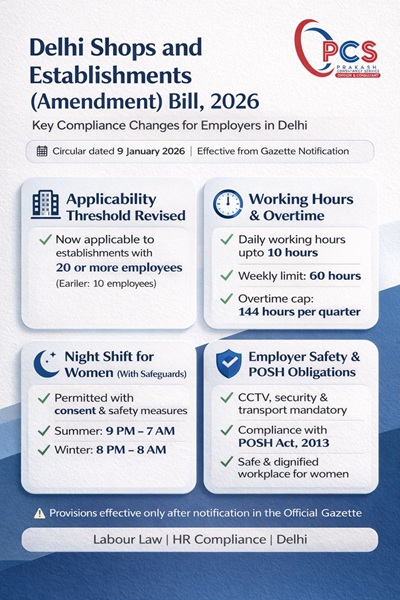


The Government of Rajasthan has issued the Rajasthan Shops and Commercial Establishments (Amendment) Ordinance, 2025, introducing several important changes that directly affect working hours, overtime limits, weekly holidays, and age-related employment provisions.
These amendments are intended to modernise labour regulation, provide operational flexibility to businesses, and at the same time strengthen safeguards against child labour. For employers, HR teams, and compliance professionals, understanding these changes is essential to remain fully compliant and audit-ready.
This article explains the amendments in a clear, practical, and easy-to-understand manner.
🔍 Background of the Amendment
The Ordinance was promulgated on 17 December 2025 under Article 213 of the Constitution, as the Rajasthan Legislative Assembly was not in session. It amends certain provisions of the Rajasthan Shops and Commercial Establishments Act, 1958 and has come into force with immediate effect.
The amendments mainly focus on:
-
Working hours and overtime flexibility
-
Weekly holiday provisions
-
Minimum age for employment
-
Employment of apprentices and young persons
✅ Key Changes Explained in Simple Terms
1️⃣ Minimum Age of Apprentice Increased to 14 Years
Earlier position
An apprentice could be engaged from the age of 12 years.
Now (after amendment)
The minimum age has been increased to 14 years.
What this means for employers:
-
No apprentice below 14 years can be engaged
-
Age verification becomes essential
-
Records must reflect compliance during inspections
This change strengthens child labour protection and aligns the law with present-day social and legal expectations.
2️⃣ Daily Working Hours Increased from 9 to 10 Hours
Earlier rule:
Employees could work up to 9 hours per day.
Revised rule:
Shops and commercial establishments may now engage employees for up to 10 hours per day.
Practical impact:
-
Greater flexibility in shift planning
-
Helpful for retail, service, hospitality, logistics and support operations
-
Rest intervals and overtime rules continue to apply
This amendment recognizes modern business realities while keeping safeguards intact.
3️⃣ Overtime Limit Increased to 144 Hours
Earlier overtime ceiling:
Only 50 hours were permitted.
Revised ceiling:
Overtime can now extend up to 144 hours.
Why this matters:
-
Businesses can lawfully manage peak workload periods
-
Seasonal and high-demand sectors benefit significantly
-
Overtime must still be paid as per statutory rates
This is one of the most employer-friendly changes introduced under the Ordinance.
4️⃣ Weekly Holiday Rule Modified (Five Days to Six Days)
Earlier provision:
A weekly holiday was required after five working days.
Revised provision:
A weekly holiday is now required after six working days.
Practical meaning:
-
Establishments can operate for six consecutive days
-
One compulsory weekly off remains mandatory
-
Removes long-standing ambiguity around weekly closure rules
This change provides better operational clarity without compromising employee rest.
5️⃣ Revised Definition of “Young Person” (14–18 Years)
Earlier definition:
Young persons were defined as those aged 12 to 15 years.
Revised definition:
Young persons are now defined as 14 to 18 years.
Why this matters:
-
Brings consistency across age-related provisions
-
Ensures clearer interpretation during inspections
-
Aligns with modern child protection standards
6️⃣ Minimum Age for Employment Raised to 14 Years
Earlier:
Employment was permitted from 12 years of age.
Now:
The minimum legal age for employment is 14 years.
Employer responsibility:
-
Do not engage anyone below 14 years
-
Maintain valid age proof documents
-
Ensure compliance during labour inspections
📊 Quick Snapshot – Key Amendments at a Glance
| Subject | Earlier Provision | Amendment (2025) |
|---|---|---|
| Apprentice age | 12 years | 14 years |
| Daily working hours | 9 hours | 10 hours |
| Overtime limit | 50 hours | 144 hours |
| Weekly holiday | After 5 days | After 6 days |
| Young person age group | 12–15 years | 14–18 years |
| Minimum employment age | 12 years | 14 years |
⚖️ Why This Amendment Is Important for Employers
The Rajasthan Shops and Commercial Establishments (Amendment) Ordinance, 2025 represents a balanced reform, aiming to:
✔ Improve ease of doing business
✔ Provide realistic working-hour flexibility
✔ Reduce interpretational disputes
✔ Strengthen child labour safeguards
✔ Align legacy law with modern employment practices
For employers, the key takeaway is timely compliance and internal alignment.
📌 Compliance Advisory for Employers
To stay fully compliant, employers in Rajasthan should:
-
Update HR policies and employee handbooks
-
Revise shift and duty-hour structures
-
Review overtime calculations and limits
-
Ensure age-verification documents are maintained
-
Update statutory registers under the Shops Act
-
Train HR and payroll teams on revised provisions
-
Prepare for inspections with updated documentation
🧾 Final Note
The Rajasthan Shops and Commercial Establishments (Amendment) Ordinance, 2025 marks an important step towards modern, flexible, and balanced labour regulation. While it offers operational freedom, it also places greater responsibility on employers to ensure lawful and ethical employment practices.
Early compliance will help avoid disputes, penalties, and inspection challenges.
Notification :- NotificationoftheRajasthanShopsandCommercialEstablishmentsAmendmentOrdinance2025