
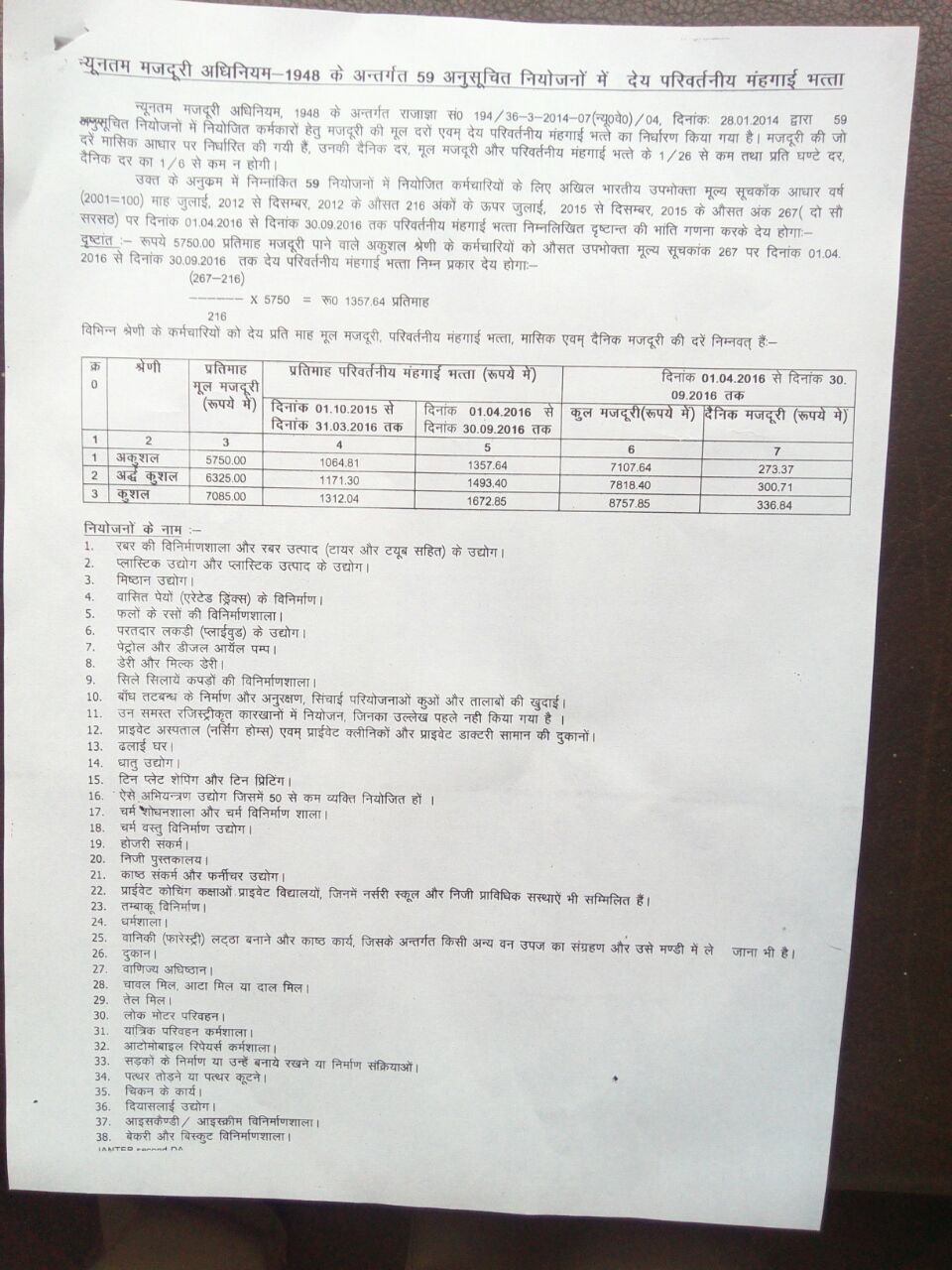
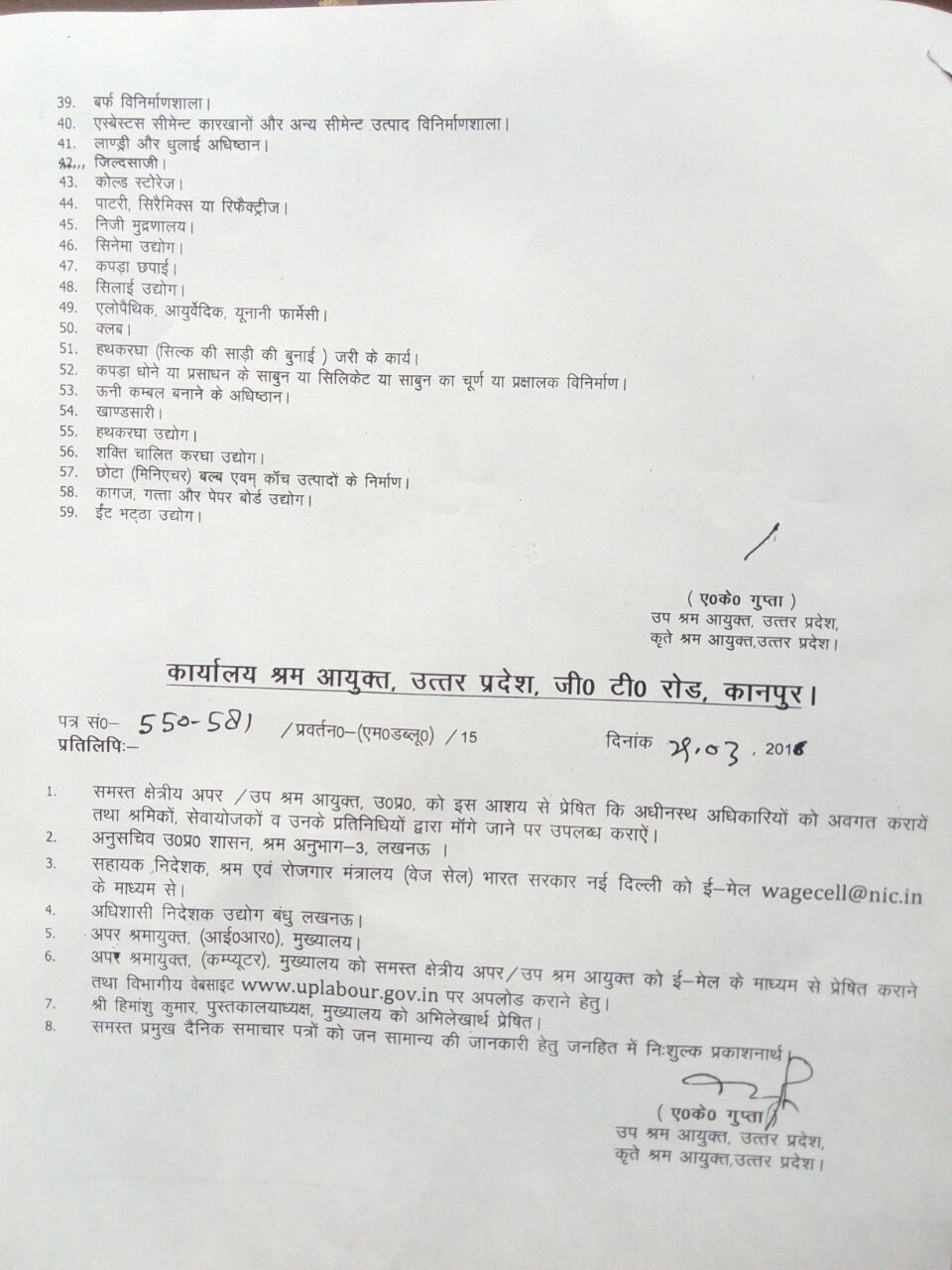
Pls find enclosed the Central VDA as declared yesterday for the period 1st Apr 2016 to 30th Sep-2016
Uttapradesh Minimu wages 1st Apr 2016 to 30th Sep-2016

Dear All

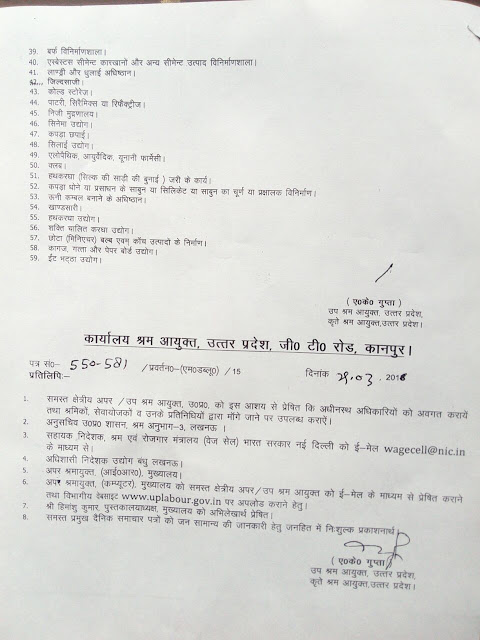
Uttar Pradesh Minimum wages 1st Apr 2016 to 30th Sep-2016
|
Category
|
Basic
|
DA
|
Total wages
|
|
Unskilled
|
7108
|
274
|
7382
|
|
Semi-Skilled
|
7818
|
301
|
8119
|
|
Skilled
|
8758
|
331
|
9095
|
EPFO all set to review withdrawal norms
The Employees Provident Fund Organisation (EPFO) board will next month review a decision to restrict withdrawals amid widespread criticism. On Tuesday, union representatives flagged the concern at the meeting of the central board of trustees and suggested that the move should be rolled back, said two sources who attended the deliberations.
“The intent was different when the proposal was discussed. But what has been implemented is completely different and against the interests of subscribers,” said a source who demanded a reversal.
Sources said with manpower restructuring consuming a bulk of the time, labour miniter Bandaru Dattatreya suggested the issue be discussed threadbare at the next board meeting. “It is an executive decision, which can be easily reversed,” said a trustee. Since early February, EPFO barred withdrawal of the employer’s contribution to PF accounts till a subscriber turned 58 years. Earlier, the entire corpus could be withdrawn if someone was unemployed for two months.
With the implementation of Unique Account Number, which allowed portability in case of a subscriber switching jobs, EPFO decided to restrict withdrawals so that subscribers had a corpus at the time of retirement which they could use. “Why should EPFO or anyone else decide how and when I withdraw?” argued a trustee, making a case for reversal of the earlier order.
EPFO to give interest on inoperative Accounts
Reversing a five-year-old decision, the Employees’ Provident Fund Organisation’s top decision-making body, the Central Board of Trustees, has decided to pay interest on all inoperative EPF accounts from April 1 onwards. Inoperative EPF accounts are those that have not received any contribution from employees or employers for 36 months. The move will benefit 90 million account holders with deposits of over Rs. 27,000 crore, but it will not apply retrospectively.
Millions of organised sector employees will start receiving interest payments on their inoperative Employees’ Provident Fund (EPF) savings from April 1 this year. Inoperative EPF accounts are those where there have been no contributions by an employee or their employer for 36 months.
Reversing its five-year-old decision which barred inoperative EPF accounts from earning interest, the Central Board of Trustees (CBT), the highest decision making body of the EPF organisation, on 29.3.2016 decided to pay interest on all such accounts. The new rule, however, will not apply retrospectively, EPFO officials said.
The decision to stop the payment of interest to such accounts was taken in 2011 in order to dissuade workers from making their accounts inactive and encourage them from merging them with an active one. A move to review earlier decision comes in the backdrop of new EPF rules introduced in February, 2016 that bar employees from withdrawing their entire PF amount till they turn 58.
“Under the new rules, when one can’t withdraw the entire amount even after being jobless for two months why should not the government pay interest on the accumulated money,” DL Sachdeva, the national secretary of All India Trade Union Congress and a member of the CBT, told HT.
On April 1, 2011 an amendment to EPF rules barred interest payments to accounts inoperative for more than 36 months.
“UPA government stopped interest on inoperative accounts. Now we have taken a pro-worker decision. The UPA government, which was claiming to be a pro-worker, stopped the interest on inoperative accounts. Now we have decided to credit interest in inoperative accounts,” labour minister Bandaru Dattatreya said after the CBT meeting
Bonus Amendment 2015 Stay in Rajashthan
Dear all,
Pls find enclosed is the Employer Association Rajasthan where in they have taken stay in the High court of Rajasthan Jaipur bench again the Bonus Amendment where in retrospective effect from 1st Apr 2014
Pls find the copy of the order for your kind persual
Order Copy Rajasthan High Court
Pls find enclosed is the Employer Association Rajasthan where in they have taken stay in the High court of Rajasthan Jaipur bench again the Bonus Amendment where in retrospective effect from 1st Apr 2014
Pls find the copy of the order for your kind persual
Order Copy Rajasthan High Court
Minimum wages of Karnataka 2016-2017
Dear all,
Karnataka Minimum wages have been declared for the Year 1st Apr 2016-2017 I have received some of the same pls refer to the below link
Shop & Commercial Establishment:- Shop & Commercial Establishment 2016-2017
Hotel Industry:- Hotel Industry 2016-2017
Karnataka Minimum wages have been declared for the Year 1st Apr 2016-2017 I have received some of the same pls refer to the below link
Shop & Commercial Establishment:- Shop & Commercial Establishment 2016-2017
Hotel Industry:- Hotel Industry 2016-2017
Security Agency:- Security Agency 2016-2017
TEA urges rollback of EPFO amendment
Tirupur Exporters’ Association (TEA) today urged the Union Labour Ministry to rollback the amendment stating that employers’ contribution withdrawal could only be done when the employee was 58 years, in the Employees’ ProvidentFund Organisation (EPFO).
In a letter to Minister Bandaru Dattatreya, TEA president A. Shaktivel said that the amendment has created ripplesin Tirupur knitwear garmentcluster, which employed four lakh workersdirectly, with 70 per cent of women being part of EPFO with an option for withdrawalon cessation of employment.
Further to this amendment, the employees can withdraw the PF account from their own total contribution including interest thereonup to date, but the employers’ contribution could be withdrawn only after they complete 58 years, he said.
Normally girls aged 18 joined garmentunits and left at the age of 23 / 24 before getting married.The new amendment has created an alarming situation in Tirupur as these women were now apprehensive about having to wait till they turned 58 to receivethe employer’s PF contribution, Shaktivelsaid.
Apart from this, Tirupur cluster was also receivingmigrant workers from North India, numbering about
75,000. The inflow from the northernstates was still increasing day by day, which was actuallyhelping to meet the labour shortage.
So, there was this apprehension that the amendment would restrict the inflow of workers to Tirupur cluster.
“We actually fear that the notification may trigger the exodus of labour and in such scenario, the garmentexporting units would not be in a position to immediately fill up the labour shortagegaps. This will lead to a chain reaction and ultimately the export businesswill drastically reducefrom the present
Considering the gravity of the foreseen repercussions,
TEA has urged the Minister to provide relief and remove the condition put forth in the amendment immediately. This would allow workers to get employer’s contribution when resigned, Shaktiveladded
Petitioning Employee Provident Fund Organization Central Provident Fund Commissioner
Dear Employee Provident Fund members,
The Employee Provident Fund Organization, which manages the EPF money, recently issued a notification amending the EPF Act to restrict the withdrawals from employee provident fund to the extent of only employee contributions and the interest on it until retirement. What this also means is that, the employee will not be able to withdraw the portion of employer contributions and the interest on it until the retirement age of 58 years.
he EPFO or the Government thinks that an employee needs the EPF money only after the retirement and happily ignored the other life stages or situations of an employee.
In this age of insecure private jobs, what will happen to the people who lose their jobs and do not find a new job?
What about the people who will not be able to work anymore due to family or medical reasons or physical incapability?
What about the people who does not want to work anymore or leave the country?
What about the people who wants to quit the job to do something on their own at some point in their career? Don’t we want more entrepreneurs and realize the dream of Make In India?
Does the EPFO or the Government wants the people, with only provident fund savings, to starve until retirement age and then withdraw the EPF money?
So, dear fellow EPF members, please sign and share the respective petition and request the EPFO to take back this new rule restricting the EPF withdrawals to only employee contributions and urge not to deprive the employees from access to their own savings when they need it the mos
Pls follow the below link & sign the petition
@courtesy :- https://www.change.org/u/156477690
SOCIAL SECURITY AGREEMENT WITH THE REPUBLIC OF AUSTRALIA
The Government of India has entered into an Agreement on Social Security Agreement with Australia. Following the principles of reciprocity this, agreement is intended to benefit the employees of both India as well as the Australia. The agreement has come into force w.e.f 01-01-2016
The Agreement provides inter-alia for posting i.e. detachment up to a period of 60 months for employees of both the countries. Accordingly the employees of one country deputed by their employers to the other country on short-term assignment for a predetermined period of up to a period of 60 months need not remit Social Security Contributions in that country. Thus the employers are saved from making double Social Security contributions for the same set of employees thereby enhancing the competitiveness of their products and services.
Employees’ Provident Fund Organization (EPFO) has been identified as the agency of implement the provisions of the agreement in India and has been authorized to issue “Certificate of coverage” to the employees of Indian establishment posted to the Australia.
The employers, who have already deputed/intend to depute their employees to the Australia can avail of this facility. The application form for this purpose is available on the official web site http://www.epfindia.gov.in. The “Certificate of coverage” will be issued by concerned RO/SRO where the application is submitted. They may also contact their jurisdictional Regional Provident Fund Commissioner or the International Workers Unit in the Head Office at 14, Bhikaji Cama Place, New Delhi -110066 for any further details.
Agreement:-Austria_Agreement
No PAN? Pay tax on PF withdrawal over Rs30,000
The government may have rolled back its budget proposal to tax employees provident fund (EPF) withdrawals, however, a number of employees, especially in the lower pay bracket, are still shelling out a hefty tax deducted at source (TDS). Eight months before the budget, a new section was quietly inserted in the Finance Act of 2015, to tax PF withdrawals over Rs30,000 where service is less than five years.
According to the new provision, any withdrawal over Rs30,000 by an employee having served for less than five years will be taxable at source. If a permanent account number (PAN) is submitted, then tax is collected at10%. There is no tax if a declaration is filed in form 15G or H, saying that the employee’s total income is not taxable. However, if there is no PAN, then tax will be straightaway deducted at 34.608%.
This is where the workers drawing low pay are being hit. Sources say many such workers change jobs within smaller periods. They also do not have PAN cards since their salary is too low to be taxable, and are also in need of PF money to meet immediate needs in case they lose a job.
However, even if their income may be much below the taxable limits, workers have to shell out tax at 34% on PF withdrawal, said a source. The notification issued by Employees Provident Fund Organization (EPFO) in this regard says that no form 15G or H may be accepted if the withdrawal is more than Rs2,50,000. This means withdrawals beyond this limit will lead to a 10% tax at the least.
PF withdrawn for termination of service due to ill health of employee, discontinuation of business or any other reason beyond the employee’s control are exempted from the TDS rule. Advances for reasons allowed under PF rules are not taxable too.
Sources say even if the well-off may not have a problem in shelling out 10% as TDS, it is the poor who do not have a PAN at all and are likely to be hit.
Figures related to the withdrawals taxed in the Nagpur office over a month show that nearly half the employees who had to shell out 30% as TDS had PF benefits within Rs50,000. Since June, over 100 withdrawals have come within the tax bracket, with total tax of around Rs 50 lakh collected.
Sources say that the amount may be minuscule, but it is the lower rung employee who is the worst hit. Many employees were left shocked when a sizeable amount was deducted as tax but had no choice, said a source requesting anonymity.
Around 5,000 withdrawals take place in a month in Nagpur, but the average amount taken back during such withdrawals stands at Rs50,000, a source said.
IN A NUTSHELL
Finance Act amended in June to tax PF withdrawals
Withdrawals over Rs30,000 after less than 5 years service come under tax net
No tax if form 15H or G declaring total income to be non-taxable
If PAN is shown, TDS is 10%
Without PAN, 34% tax is deducted
Many lower rung employees have no PAN
They have to pay tax even if income much within limit
@courtesy http://timesofindia.indiatimes.com/
Shishir Arya | Mar 16, 2016, 03.01 AM IST