
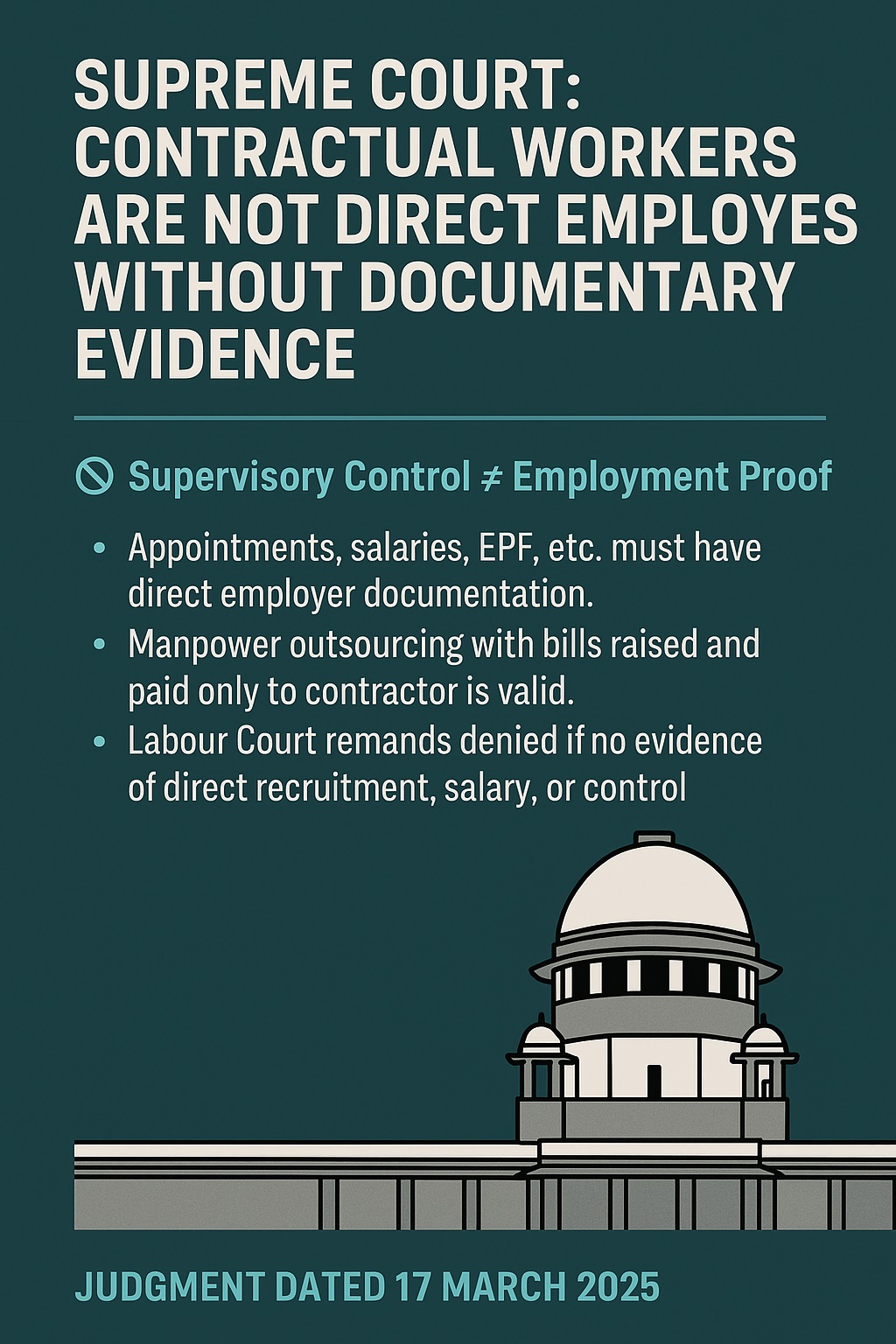


🏛️ Supreme Court Rules in Favour of CBSE: Contractual Workers Are Not Direct Employees Without Documentary Evidence
Date of Judgment: 17 March 2025
Bench: Justice Ahsanuddin Amanullah & Justice Prashant Kumar Mishra
Category: Labour Law | Employment Dispute | Contractual Workforce | Supreme Court Judgment 2025
🔍 Introduction: Major Relief for Employers Engaging Outsourced Workers
In a landmark verdict that will significantly impact labour law compliance, manpower outsourcing contracts, and HR practices in India, the Supreme Court of India has delivered a clear and authoritative ruling — contract workers cannot claim permanent employee status without solid documentary proof of direct employment.
This judgment arose from the case of CBSE vs. Raj Kumar Mishra & Others, where individuals hired through a contractor claimed to be direct employees of the Central Board of Secondary Education (CBSE).
The apex court’s decision is a huge relief to thousands of employers — including schools, hospitals, PSUs, factories, IT firms, and other businesses that hire through manpower service providers.
📝 Background of the Case
What Triggered the Dispute?
- Private respondents (including Mr. Raj Kumar Mishra) were deployed at CBSE offices through a manpower outsourcing agency — M/s. Man Power Services & Security.
- Over time, they alleged that they were working under direct control and supervision of CBSE, and therefore, must be considered regular CBSE employees.
- The Labour Court ruled in favour of the workers, treating the relationship as one of employer-employee.
- The Allahabad High Court then set aside this award but remanded the matter back to the Labour Court.
- CBSE challenged this remand order before the Supreme Court of India.
⚖️ Key Legal Questions Before the Supreme Court
- Can a contract worker claim to be a direct employee if the employer exercises supervisory control?
- Does assignment of duties or transfer across locations imply an employer-employee relationship?
- Is it lawful to remand the matter back to the Labour Court when no direct employment documents exist?
🧑⚖️ Supreme Court’s Observations & Reasoning
❌ Supervisory Control is Not Employment Proof
The Court ruled that supervision or direction in daily tasks by the principal employer does not by itself establish employment. For a legitimate employer-employee relationship, documented proof is a must — such as:
- Appointment letters
- Salary slips
- Bank transfers from the principal employer
- EPF/ESIC registration records
- Direct contractual obligations
📄 Outsourcing Validity Confirmed
The Court accepted CBSE’s evidence that the workers were engaged by a contractor, and CBSE had:
- No direct employment contract
- Paid contractor bills, not individual salaries
- Allocated duties as representative beneficiaries of manpower supply, not as employers
🛑 Labour Court Remand Denied
The Court noted that since no documentary evidence existed to support the workers’ claim, sending the case back to the Labour Court would be a wasteful exercise. It upheld the principle that litigation must be based on evidence, not assumptions.
🏁 Final Judgment Summary
|
⚖️ Outcome |
✔️ Verdict |
|---|---|
|
High Court remand |
Set aside |
|
Labour Court awards |
Quashed |
|
Employment claim by workers |
Rejected |
|
CBSE’s appeal |
Allowed |
|
Pending applications |
Disposed of |
🧠 “A direct master-servant relationship must be established on paper. Supervisory control alone is not enough to prove employment.” – Supreme Court of India
🧩 What This Means for Employers
📌 If You Engage Contractual Workers:
✅ Ensure clear agreements with manpower agencies
✅ Route all salary payments through the contractor
✅ Avoid issuing internal memos or emails directly to contract workers
✅ Maintain records of invoices, job orders, and duty allocations via the contractor
✅ Register all workers only under the contractor’s ESIC and EPF codes
👨💼 Impact on HR Managers, Legal Teams, and Business Owners
This judgment strengthens legal protection for employers and ensures that contract staffing cannot be misused by workers to claim permanency without proof.
It will help:
- Prevent misclassification of workforce
- Reduce false litigation
- Promote better manpower contract governance
- Guide HR and admin teams during labour inspections or disputes
⚠️ Key Takeaways for Contract Workers
If you’re working through a manpower agency, remember:
- Your legal employer is the contractor, unless you hold direct employment documents from the company.
- You cannot claim to be a permanent employee just because you follow instructions or are supervised by someone from the company.
- To claim permanency, you must show clear evidence of direct recruitment, salary, and control.
📚 Case Snapshot
|
Case Title |
CBSE vs. Raj Kumar Mishra & Others |
|---|---|
|
Case No. |
Civil Appeal arising from SLP(C) Nos. 19648/2023 & 22030/2023 |
|
Court |
Supreme Court of India |
|
Date of Judgment |
17 March 2025 |
|
Judges |
Justice Ahsanuddin Amanullah & Justice Prashant Kumar Mishra |
|
Category |
Labour Law – Contractual Employment |